
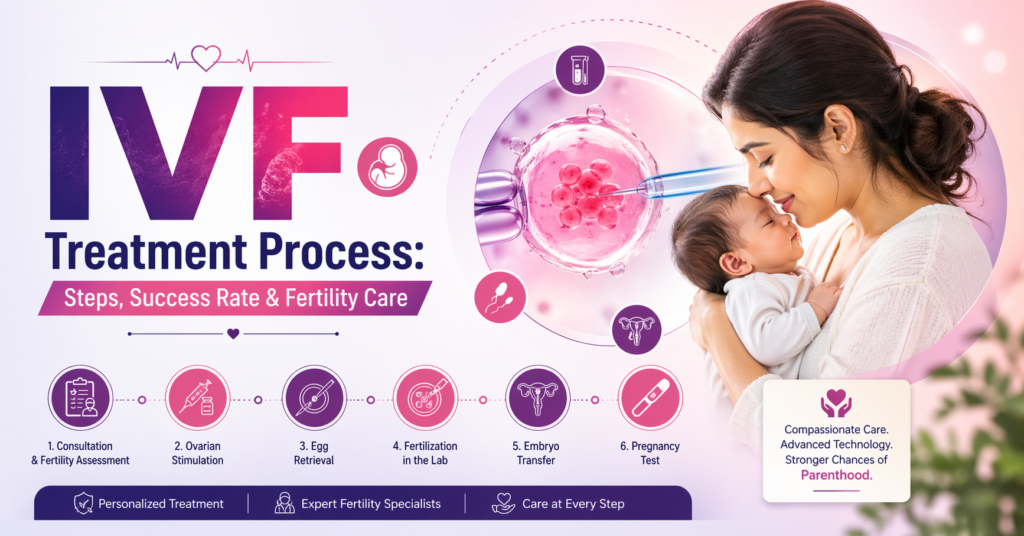
Starting the journey toward parenthood isn’t always simple. For many couples, natural conception takes time, patience, and sometimes medical support. This is where understanding the ivf treatment process becomes important—not just as a medical procedure, but as a structured path filled with hope, science, and personalized care.
In this guide, you’ll get a clear, real-world understanding of how IVF works, what to expect at every stage, success rates, and how specific conditions like high AMH levels can influence your fertility journey.
IVF (In Vitro Fertilization) is a fertility treatment where an egg and sperm are combined outside the body in a lab. Once fertilization happens, the resulting embryo is carefully transferred into the uterus to support pregnancy.
Unlike basic fertility treatments, IVF is more controlled, more precise, and often recommended when other methods don’t work.
Not every couple needs IVF, but it’s usually suggested in cases like:
Many couples exploring advanced fertility options often consider services like
https://www.tietenmedicity.com/service/best-ivf-centre-in-thane/
to understand their eligibility and treatment plan.
Let’s break down the ivf treatment process in a way that actually makes sense without overwhelming medical jargon.
1. Initial Consultation & Fertility Assessment
This is where everything begins.
Doctors evaluate:
This step helps create a personalized treatment plan instead of a generic one.
2. Ovarian Stimulation
The woman is given hormonal injections to stimulate the ovaries to produce multiple eggs instead of just one.
Why this matters:
More eggs = higher chances of successful fertilization.
This phase usually lasts 8–14 days with regular monitoring.
3. Egg Retrieval (Ovum Pickup)
Once the eggs are mature, they are collected using a minor surgical procedure.
This step is crucial because egg quality plays a huge role in success.
4. Fertilization in the Lab
The collected eggs are combined with sperm in a lab.
Two methods are used:
After fertilization, embryos are observed for quality and growth.
5. Embryo Transfer
A healthy embryo is selected and transferred into the uterus.
This is the moment where everything comes together.
6. The Two-Week Wait
After embryo transfer, there’s a waiting period of around 10–14 days before pregnancy testing.
This phase is emotionally intense, and proper care is essential.
IVF success is not just a number—it depends on multiple real factors:
1. Age Factor
2. Egg & Sperm Quality
Better quality = better embryo development.
3. Clinic Expertise
Advanced labs and experienced doctors improve outcomes significantly.
4. Lifestyle
5. Shorter Hospital Stay
In some cases, patients go home within 24–48 hours.
AMH (Anti-Müllerian Hormone) indicates ovarian reserve.
High AMH Means:
But here’s the catch:
High AMH doesn’t always mean better fertility
Risks with High AMH:
How Doctors Manage It:
This is where choosing the right fertility center becomes critical for safe and effective treatment.
IVF is not just a procedure—it’s a process that requires complete care.
Physical Care
Emotional Care
Let’s be honest—IVF can be mentally exhausting.
Support systems matter:
Medical Care
Follow every instruction strictly:
Even small mistakes can impact results.
Many couples ask:
“Why IVF and not something simpler?”
IUI (Intrauterine Insemination)
IVF
Myth 1: IVF always works in one attempt
Reality: It may take multiple cycles.
Myth 2: IVF guarantees twins
Reality: Single embryo transfer is common today.
Myth 3: It’s only for women
Reality: Male infertility is a major factor too.
Myth 4: IVF babies are not healthy
Reality: IVF babies are as healthy as naturally conceived babies.
Simple but powerful steps:
If you’re seriously considering treatment, exploring a trusted center like
https://www.tietenmedicity.com/service/best-ivf-centre-in-thane/
can help you understand personalized treatment options and improve your chances.
IVF cost varies depending on:
Approximate range:
₹1.2 lakh – ₹2.5 lakh per cycle
Additional procedures may increase cost.
You should consult a specialist if:
Early consultation = better outcomes.
The ivf treatment process is not just about science—it’s about timing, care, and the right guidance. Every step, from diagnosis to embryo transfer, plays a role in shaping the final outcome.
For couples facing fertility challenges, IVF offers not just a solution, but a real chance at parenthood when handled with the right expertise and emotional support.
Typically, one IVF cycle takes about 4–6 weeks from start to pregnancy test.
Most steps are manageable. Egg retrieval may involve mild discomfort, but it’s done under sedation.
It varies based on age and health but generally ranges between 30%–60% per cycle.
Yes, not all cycles succeed. Multiple attempts may be required.
Yes, when done under expert supervision, IVF is considered safe.
Yes, it may increase risks like OHSS, but doctors manage it carefully with customized protocols.
It depends on individual response. Some succeed in one cycle, others may need more.
Avoid smoking, alcohol, stress, and skipping medications.

