
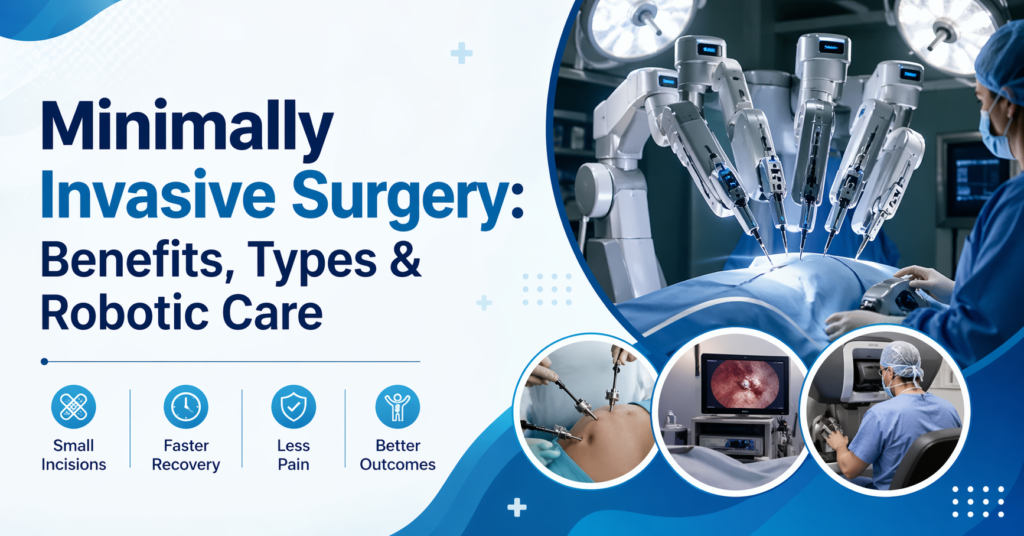
Minimally invasive surgery has quietly changed the way modern medicine works. A few years ago, major operations meant long cuts, visible scars, and weeks of recovery. Today, many procedures are done through tiny openings, guided by precision tools and advanced technology.
If you’ve been advised surgery, chances are your doctor has mentioned options like laparoscopic or robotic procedures. But what do these actually mean? And more importantly, how do they affect your recovery, safety, and results?
Let’s break it down in a way that actually helps you decide.
Minimally invasive surgery is a technique where operations are performed through small incisions instead of large cuts. Surgeons use specialized instruments, cameras, and sometimes robotic systems to carry out procedures with high precision.
Instead of opening up the entire area, a tiny camera (laparoscope or robotic scope) is inserted. This gives a magnified view of the inside of your body on a screen, allowing surgeons to work accurately without causing unnecessary damage.
In simple words:
Less cutting outside = less trauma inside = faster recovery.
Not all minimally invasive procedures are the same. Depending on your condition, doctors may suggest one of the following:
1. Laparoscopic Surgery
This is the most common form.
Used for:
It’s effective, but the surgeon’s hand movement is still somewhat limited.
2. Robotic-Assisted Surgery
This is the advanced version of minimally invasive surgery.
A robotic system assists the surgeon, but the surgeon is still in full control.
If you want to explore how this works in a real clinical setup, you can check this detailed page on
👉 https://www.tietenmedicity.com/service/robotic-surgery-in-thane/
Used for:
Best for cases where precision matters the most.
3. Endoscopic surgery
Let’s make this simple:
Factor | Open Surgery | Minimally Invasive Surgery |
Incision size | Large | Small |
Pain | High | Less |
Hospital stay | Longer | Shorter |
Recovery time | Weeks | Days to weeks |
Scarring | Visible | Minimal |
Infection risk | Higher | Lower |
For most patients, minimally invasive methods are clearly the better option-when suitable.
This is where things get interesting.
1. Faster Recovery
Patients often return to daily life much quicker compared to traditional surgery.
2. Less Pain
Smaller cuts mean less tissue damage → less post-surgery discomfort.
3. Minimal Scarring
This matters not just cosmetically but psychologically too.
4. Lower Infection Risk
Smaller wounds = fewer chances of complications.
5. Shorter Hospital Stay
In some cases, patients go home within 24–48 hours.
5. Better Precision (especially robotic)
Robotic systems allow movements that are more accurate than human hands alone.
Robotic-assisted surgery is not just a trend—it’s solving real limitations of traditional techniques.
Key advantages:
It’s especially useful in delicate surgeries where every millimeter matters.
Doctors usually suggest this approach when:
Common conditions include:
Let’s keep it real—no surgery is 100% risk-free.
Possible concerns:
But overall, complication rates are lower compared to traditional surgery when done properly.
Recovery is usually smoother, but still depends on your body and the procedure.
What to expect:
Tips for better recovery:
Cost varies depending on:
While robotic surgery may cost more upfront, it can reduce:
So in many cases, the long-term value balances out.
This part is often ignored—but it shouldn’t be.
For minimally invasive or robotic surgery, look for:
If you’re evaluating options, you can explore advanced robotic procedures offered here:
👉 https://www.tietenmedicity.com/service/robotic-surgery-in-thane/
Minimally invasive surgery is not just about smaller cuts—it’s about smarter treatment.
It reduces pain, speeds up recovery, and improves overall outcomes. And with robotic assistance, the level of precision has gone even higher.
That said, the best approach always depends on your specific condition. The right surgeon and the right setup make all the difference.
Yes, it is generally very safe and often safer than open surgery when performed by experienced surgeons.
Most patients recover within a few days to a couple of weeks, depending on the procedure.
Robotic surgery offers better precision and flexibility, especially in complex cases, but both are effective.
Scars are very small and usually fade over time.
It can be slightly higher than traditional surgery, especially robotic procedures, but offers better recovery benefits.
No. Some complex or emergency cases may still require open surgery.
Your doctor will evaluate your condition, medical history, and overall health before recommending it.